The problem
An agent starts at a base at position 0 on a line that stretches forever to the right. Somewhere along it is a target, possibly moving in a zigzag, and the agent has to find it and return it to base efficiently. The source paper solves it with an algorithmic approach, a carefully designed search strategy. This project recreates it with reinforcement learning instead, asking whether an agent can learn a comparable strategy from reward alone, and measures how well it does with the competitive ratio, checking results against the paper.
Approach
- Built a custom Gymnasium environment, InfiniteLinearSearchEnv, with configurable target range, optional target movement (zigzag, with set probability and speed) and step limits
- Structured the task into phases the agent learns to move through: initial exploration, return to base, full exploration, and rescue
- Implemented a tabular Q-learning agent with epsilon-greedy action selection, adaptive bias and experience replay
- Shaped the reward: a small per-step penalty, bonuses for visiting new regions, +500 for finding the target, +1000 for completing the rescue, and penalties for counter-productive moves
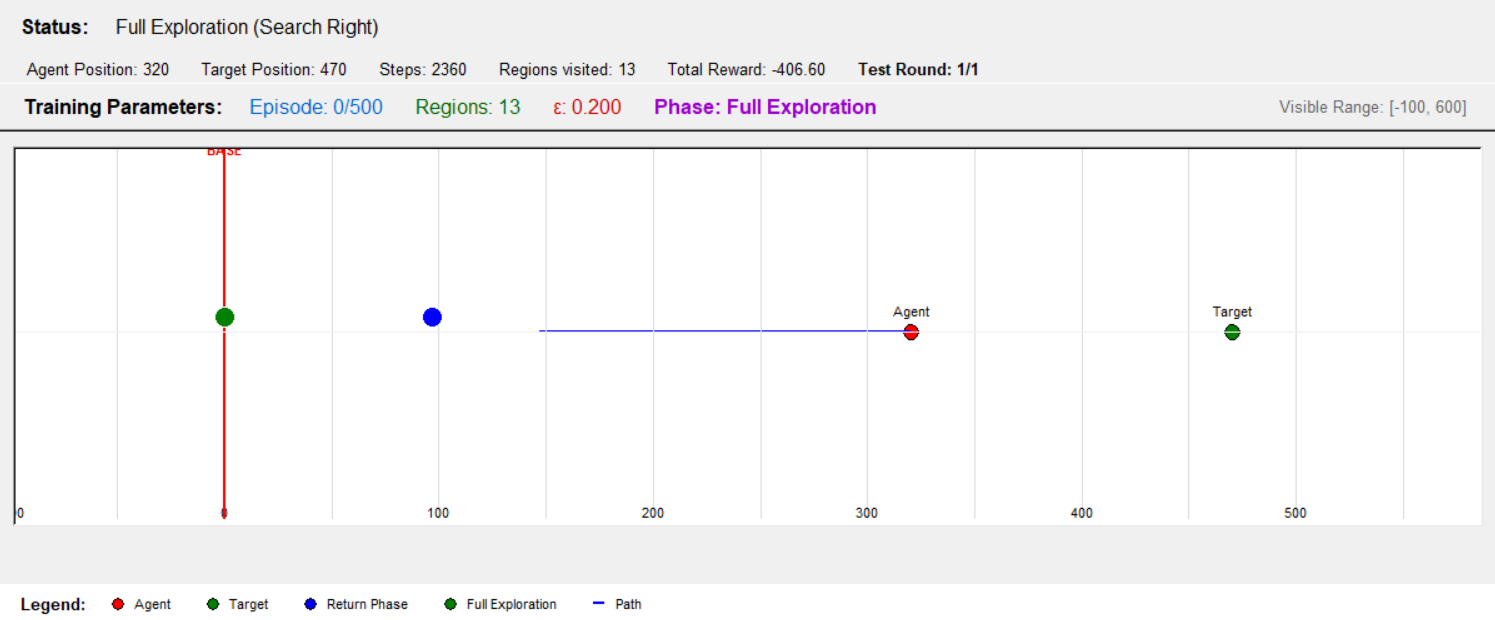
- Built a Tkinter visualizer showing the agent, target, path and live metrics, with dynamic scaling and panning; test mode runs many episodes and reports the average competitive ratio
- Saved Q-tables to disk so trained agents can be reloaded and tested later. Built the environment and visualizer with Codex, validating results against the paper
Highlights
- Recreates a published algorithmic approach using reinforcement learning
- Optional moving target with configurable speed and probability
- Real-time visualization of training and test episodes
- Reports the average competitive ratio over many test runs